Showing posts with label winter wheat. Show all posts

Tuesday, July 28, 2015

Winter Wheat Harvest 2015

What a crazy growing season it has been!

Harvest is really when we see what we have for a crop. It's a reflection of a year's worth of planning and work, mixed with some luck.
Grain cascades out the back of the truck in to the hopper of the auger, where it is carried up into the grain bin.
As you may have read in my harvest post from last week, we started cutting winter wheat last Monday and went pretty hard for seven days straight. The crop is mostly decent in some places for the weather conditions we had throughout the growing season this year. Our bushels per acre are definitely down from what they have been in recent years for winter wheat and in some fields, they're downright poor with barely enough yield to pay for running the combine. The crop is what it is and there's not as much of it, so it's just a matter of getting it cut and moving on.

Jeff walks between the tractor, which powers the auger, and the grain truck.

Montana is the third-highest wheat producing state in America, after Kansas and North Dakota. Hill County, where our farm is located, is right in the middle of what's called the "Golden Triangle,"--one of the best wheat-producing areas in Montana. Hill County had a doozie of a weather pattern this year-- drought conditions through the first six months of the year, then a horrendous 4th of July hail storm. So, what that means is farmers who may have had thinner-than-normal crops to begin with due to drought, then got hit with hail, which in some cases, knocked down what was left. According to this article from the Great Falls Tribune, Hill County experienced over seven million dollars in hail damages: Hill County Hail Damage Could Exceed $7.5 Million Farmers saw a significant portion of that damage. Our own farm was affected.

Winter wheat near Minneota Hall that was cut on Sunday. Sweetgrass Hills in the background.
This is the first year of implementation of the new protection programs for farmers from the most recent Farm Bill and we are learning all about how that works. Let it be known to my non-farming readers that no farmer wants to see their crop do poorly; everyone wants to cut a gangbuster crop every year. No one wants a "hand-out" from the government. But, if there weren't protection programs and Farm Bills in place, there wouldn't be farmers. Some years, the crop is not a bin-buster, but a complete bust. A successful Farm Bill keeps farmers farming and keeps food and land in production.

A wheat field, baled as hay to use for our animals, rather than being harvested for grain.
The above photo is of some land that a neighbor of ours farms. His crop was unfortunately so poor that it wouldn't have paid for him to harvest it. But, you still have to clear the field somehow so it can be ready for it's next crop. So, we used a swather to cut the wheat and make hay bales, which we'll feed to our cows this year. Sometimes you just have to be a bit creative and think of other ways to use what you have.

Grain bins between Minneota Hall and the Inverness Road.
After shutting the combine down for the evening on Sunday night, we haven't started it up again yet this week. It started raining on Sunday and has gone off and on until this morning. Hopefully tomorrow we can cut the last 100 acres or so of winter wheat. Then, it will be time for barley, then spring wheat.

Before the night was over on Sunday, however, we did take part in what is sometimes a harvest necessity, but definitely a tradition: meal in the field! Sometimes, the location where they're cutting wheat is far from the house or it is inconvenient for the harvest crew to come in to the house to eat dinner. So, whoever is in charge of cooking will take the meal out to them. Sunday night was one of these occasions. It just happened that we were cutting right by Minneota Hall, which is an old community call out in the country near our farm, so it worked perfectly to serve the meal right on the cement step in front of the hall!

Carol cooked. We had hamburgers, pasta salad, chips, and fruit, served out of the bed of the pickup.
Carol and Jeff eat while Tom (unpictured) makes another pass in the combine.
When we eat in the field, the guys typically take turns so that the combine can keep rolling.
It seems like it was the winter wheat that was hit the worst by the drought. We had pretty outstanding sub-moisture last fall for winter wheat seeding, and then a warm and mild spring. So, the winter wheat came up hard and fast early in the season, using up all the soil moisture that was available. Then, when the rain stopped, the winter wheat stopped. By the time the storm of the 4th of July hit, it was really too late to be helped by the rain that did come along with it. We've had the rain in July that our crops desperately needed in May and June. Our spring wheat and barley still had a chance to be influenced and helped by a little rain. So, we'll see how it looks when we start cutting those crops.

Harvey stalks a bunny.
Just for fun, here's a photo of Harvey stalking a rabbit. He stalks them and chases them, but almost never catches them. Stay tuned as harvest and farm proceedings continue!

Friday, July 24, 2015

Starting Harvest

It is *officially* harvest!

We started cutting winter wheat on Monday afternoon. That morning, I helped Jeff quite a bit with all the very-last-minute preparations. We cleaned out a grain bin and swept out a truck. I washed all the windows on the combine, even the ones inside the hopper. 
This is what the inside of a grain truck looks like. 
 The sky was a bit broody on Monday, but no storms that night. This year, we grew winter wheat, yellow peas, spring wheat, and barley. After we finish cutting the winter wheat, we'll probably move on to barley, and then finish on spring wheat. We're actually not cutting our peas at all this year, but that's a topic for a separate post.

Each morning, to start the day, the combine is serviced and gassed-up, and the windows are washed. This is just to hopefully maintain smooth operating with this beast of a machine. Daily greasing and cleaning keeps it running as efficiently as possible.
Jeff gets into one of the hard-to-reach places on the combine with a grease gun, while Harvey looks on.
 Also, just because it's harvest doesn't mean that other farm work can be completely neglected. Jeff has been getting up very early every morning to spray while the wind is down. Then, he'll spend a full day on the combine or driving truck. He had been spraying our peas (again, it's a long story for another post, perhaps), and then this morning began spraying the fallow fields. I could probably do an entire post just about spraying-- why we do it, pros and cons, etc. So, that's another one that could be coming down the pike sometime, folks! But this post is about harvest kicking off, so let's continue with that!
I took a break from cleaning the windows and mirrors for a photo op. 
 Harvest is easily the busiest time of year for us. Remember that we spend an entire year planning and working just for this season, to harvest our grain. A significant portion of our income is based solely on how the crop does. I always like to make the analogy that harvest for us is like tax season for an accountant, or like Black Friday in retail. This is when you hope to make it into the black, so to speak.

I'll be doing several more posts as harvest continues on about how it's going, so stay tuned for that. I also want to give a big shout out to my friend Christy. She lives and works on a big beef ranch and dryland farm, similar to our operation only they're bigger on cows and less on crops while we're heavier on crops and less on cows. Christy is a very active member of Team Beef Montana and has a great running blog with many, many followers. We met in person at the Montana Farmer's Union Women's Conference last spring and she stood up during a goal-making session and said she'd like to spend more time on her running blog educating her readers about her farming and ranching lifestyle. She is definitely making her goal a reality! She has a really fantastic post today about her family's wheat harvest, which is also underway, and I highly recommend you check it out: You Like to Eat, Right? Learn A Bit About Your Food!
Golden winter wheat under that big Montana sky!
Happy harvesting, everyone!
If you are a farmer, how does harvest typically go for you?
If you're not a farmer, what would you say is your busiest, most important time of the year?

Sunday, July 19, 2015

Wildlife Encounters~The Big One

Sunset over ripe winter wheat, Sweetgrass Hills standing sentinel. 
One of the best things about living in a very rural place is that we see all kinds of wildlife on a regular basis. We see deer and antelope, for example, pretty much every day. And it doesn't get old!

Lately, we've been spending a bit more time than normal driving around on crop tours, assessing how close we are to being able to cut wheat and get harvest underway. With all the extra time spent out in the field, we've been seeing even more wildlife than normal. In some cases, we've been VERY up close and personal!

This post is very photo heavy-- photos are from me and Jeff of wildlife encounters! Some of them are a bit blurry because it can be difficult to photograph an animal on the move with a cell phone camera. Enjoy!

Pronghorn Antelope grazing on a stubble field.
Starting off with antelope. Pronghorn Antelope are fairly pedestrian where we are. We live in one of the most densely populated antelope counties in Montana. It's quite possible that antelope outnumber people. We see them all the time. They're still cool.
Antelope Buck in wheat field.
They're especially cool when you see a monster buck! This is one of those blurry photos. He only stopped briefly... apologies. Hope you can still get an appreciation of his grandeur!

Mule Deer bucks in velvet.
And then there are the deer! Jeff and I spotted these while down in the creek in one of our pastures. They were easily within 100 yards of us, maybe even closer, when we first saw them. Three young (small) mule deer bucks, in velvet. Again, photo is blurry. :(  Still, very cool.
Rocky Mountain Elk in crop stubble.
Don't forget about the rare elk sighting! We do have some elk around, but as I said, they're very rare. Not this guy, though. He was just trotting through some crop stubble about a mile south of our house. Jeff got this photo on his way home from his parents' place. Probably a small cow or yearling bull. No antlers. Tom, my father-in-law, just saw two larger bull elk in his pasture yesterday, full racks in velvet. Maybe he can keep them there until hunting season starts?! Maybe there's getting to be more elk around. We don't have much for predators, so it wouldn't surprise me if elk population is on the increase.

See if you can spot the wildlife in this next photo.
I'll give you a hint: I'm not talking about Harvey!


Here's a close-up...
We were out scouting crops and decided to hand-pull a few scattered weeds. It's a really good thing I didn't just reach in and grab this kochia plant!

Actually, I did pull up the plant that was close to this one-- about three feet away. And Harvey had just been right by that same spot, you know, doing his business...

The snake waited a LONG TIME to rattle. Boy, am I glad he warned us before I reached in there to pull out his cover! Could have ended in disaster.

When he did start rattling, I nearly jumped out of my skin. Jeff told me later he was proud of the string of cusswords I spat out as I got the hell away from that rattling snake! Definitely the closest I've ever been to a snake. My hand was within two feet of him when he rattled. Yikes. Needless to say, we decided to let the weeds grow a little longer after that and went home and had a beer. You know, to calm the nerves.  Being close to a rattling snake really gets your adrenaline pumping. Holy cow.

But the summer reptilian sightings are not done, alas.

Just this morning I was out walking Harvey. He had been pointing and flushing a lot of birds and really enjoying himself on our walk. Then he pointed and held his point for a very long time. I walked up to him to see if he'd release and flush and he just held it. I looked along the trajectory of his point and there, about six feet ahead, right in line with Harvey's nose, was a GIANT rattlesnake. I'm officially naming him The Big One. You can see most of his rattle in the photo below. He's not small.

I think it's very possible that this is the same snake that bit Harvey earlier this summer. When we saw him this time, he was halfway inside a gopher hole. He had no idea we were there watching him, and we were not close enough to get bit anyway. If he had emerged from the hole, you can bet we would have high-tailed it away from him pretty damn fast. You can see he's pretty girthy. He's probably been feasting on gophers and voles all summer. I think he was eating one right as we stood there and watched.


If you look really closely in this next photo, there's some snake skin that's clearly a different color. It's darker and more brown. When The Big One would wiggle and move around (still within that hole) the darker colored part didn't move at all. I didn't get any closer to investigate, for obvious reasons, but I think it could either be a second, live snake, OR perhaps a dead snake. It definitely was not an empty, shed snakeskin. It had flesh. And it wasn't attached to The Big One, i.e. not just still part of The Big One's body.

 Maybe they're a pair snakes? Maybe they have a nest? Maybe The Big One killed that other one for encroaching on his food source? Kind of hoping it's not a nest. In any rate, I plan to drive back up there later and see if I can find the snakes again (in a safe and cautious manner). I remember exactly where they were. If they're both gone, then at least I'll know that there were two live snakes. **shudder**

I am really proud of how smart Harvey was, though. He pointed the snake as if to let me know that the snake was there. He didn't charge toward him as if he were flushing a bird, he just held his point. "Mom, there's a snake down there! Be careful!" And then he just sat down right next to me calmly. Seriously, dogs are so smart. How often do I wish they could tell us humans everything they know. Oh, what we would learn! I'm grateful to have a dog that can at least communicate with me by pointing. Pretty dang cool. :)
Harvey the Vizsla, traipsing through a field of winter wheat. 

Tuesday, September 23, 2014

Fall Seeding and Winter Wheat 101

The official beginning of Fall is upon us and with that, we are still busy on the farm. Even though it snowed right as we were arriving home from Washington D.C. (You can read about the trip in the three previous posts), we have had Indian Summer since then. Temperatures have been in the 70s and 80s for the past ten days or so now. Warm weather on top of the very wet August we had is making the ground ideally temperate for winter wheat seeding, which Tom, Jeff, and Stennie have been busy with over the past few weeks.
The air-drill, or seeder, was parked in our yard for a few days in between seeding Tom and Carol's land and seeding our land. It is a behemoth.
Tom's land was seeded first, and now Jeff and Stennie have moved on to seeding our land. Between the two farms, we'll have 1350 acres seeded to winter wheat. Everything has been going great so far-- minimal equipment breakdowns, good weather, etc. (I probably shouldn't even write that, for fear of jinxing things!) If everything continues to go well, we should be finished seeding within the next few days. Just in time for the rain that's supposed to come on Saturday!

In case you're not familiar with winter wheat, it is seeded in the fall. In good conditions, it germinates and sprouts in the fall, then sort of dies off when heavy frost and/or snow hits. It's not actually dead, though. The plants lie dormant throughout the winter, then sprout again in the spring and grow over the summer for harvest in late July or early August. It has a pretty interesting life cycle.

If the seed never germinates in the fall, then it won't come up in the spring at all. Another problem that can sometimes happen is if the top of the ground gets covered with a layer of ice over the winter, the seed can actually die. In that case, nothing comes up in the spring, either. This scenario happens if, for example, we get a snow or sleet event, then it warms up and melts, then we get a hard, sudden freeze, creating that layer of ice. A lot of weather phenomena stringed together has to happen in order to winter kill in that way, but it does happen sometimes.

We use winter wheat in our rotation, but not usually as the sole crop on our farm. Typically, we rotate spring wheat, a pulse crop and/or barley, and winter wheat, with a year of fallow in there somewhere, too. Although, since we really have only been farming for a few years, we are truly still establishing our rotation.   Last year, Jeff and I only seeded spring wheat on our land. This year, we are seeding quite a bit of winter wheat, because the fall conditions are so good. But, we won't seed all of our plantable acres to winter wheat this fall. We will save some for spring seeding of peas and spring wheat. We're also thinking about possibly some durum in the spring, too.

One question we get sometimes is-- what is fallow? I'll admit that, not being from a farming background myself, I didn't understand the word or what it meant in a farming sense. Lying fallow means that a piece of ground has nothing planted on it at all for a season. It's just left alone. Around here, we have to do that because we are dryland farmers, meaning we do not irrigate our fields, and we have so little rain. Leaving ground fallow every other year or every third year helps conserve moisture in the soil. Right now, we are seeding winter wheat, for the most part, on fields that were fallow during this year's growing season.

Not every farmer incorporates fallow in their rotation, even up here in the dryland country. Where I grew up in Iowa, most farmers seed every acre of their land every year. This concept is called continuous crop. Sometimes, if we do seed the same acres in back-to-back farm years, we also refer to those acres as re-crop.
Fall sunrises are so beautiful!
So there you have it! A winter wheat and crop rotation primer. Please leave comments if you have any questions or want to know more. Wish us luck as we wrap up fall seeding!
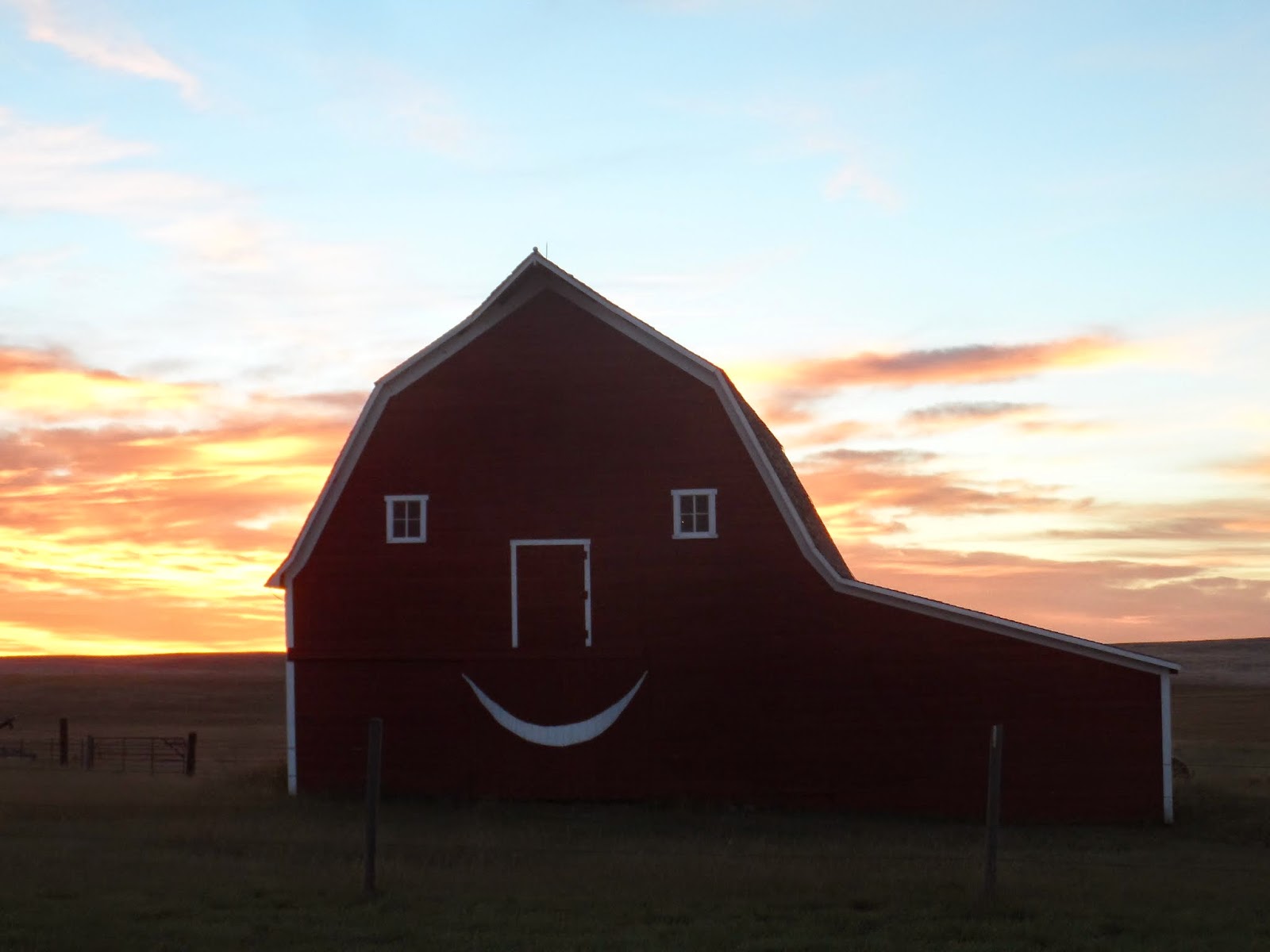
Sunrise behind our happy barn. 


Tuesday, October 29, 2013

First Snow

Sunday, October 27 began the first snowfall of the season.  We were driving north, towards home, from Bozeman, ending another football weekend when we hit the weather wall.  The temperature dropped and the cold northeast wind slapped our cheeks with a wintery wakeup call.

The snow began in the afternoon, striking the north-country first.  By Monday morning we had about two inches on the ground, and some minor drifts. The temperature went from the upper 50s/low 60s to highs in the low to mid 20s overnight. It feels wintery.  The Farmers Almanac said it is supposed to be a rough winter this year, so I guess it?s getting started early.

Our calves shipped out last Thursday so we are left with just the mama cows, who we hope are now pregnant again.  They?ll calve in March, like every year.  Jeff and I again have the replacement calves at our place to overwinter.  At this point in their lives, the calves are like preschoolers; they are energetic, excitable and nervous, but very curious.

Winter wheat planted earlier this fall should surely go dormant now. It will sprout again in the spring, spurred by warming temperatures and longer days.  Winter wheat reminds me of a phoenix. It seemingly dies in the fall only to rise again and reach its full potential in spring and summer.

We spent time on Friday before heading to Bozeman winterizing machinery and the yard in preparation for the first snow of the season.  I finally got around to pulling the dead tomato plant stalks and other dried stems from our container garden, and I learned how to use the weed whacker to do a little trimming around the yard. Jeff worked on machinery and moving rigs and implements into winter storage.  We joked that perhaps we need the threat of a winter storm every weekend to keep us on track with chores and yard work.

Agriculture is married to the seasons and the weather.  We cultivate life, either in plant or animal form, following the parameters set by the weather.  Seasons change and cycles of life continue and repeat.  Sometimes, like this past weekend, the weather kicks us into gear and reminds us where we should have been all along.


Monday, August 19, 2013

Harvest Mid-Point Report

 
We are really in the thick of harvest right now.  The official first day was July 28- Jeff and I cut a few peas that night.  Following that, harvest was routinely interrupted by rain events impacting the region.  Again this year, thankfully, both Jeff and I and Tom and Carol escaped the pop-up showers and thunderstorms with very minimal hail damage.  Some of our neighbors were not so lucky. We also were getting used to the quirks of a new combine and header set up early on in harvest. Now, with inclement weather and machinery breakdowns behind us (knock on wood) we are able to roll through the acres.

We finished with all the winter wheat Saturday evening and decided to move on to spring wheat. Though the late-season rains put a slight delay on cutting some crops, rain is almost always good for the quality of the crops.  This makes for happy farmers and lots of bushels being cut.

I have not been around long enough to appreciate fully what a blessing rain (with no hail) can be. Tom was telling me today about some of his land referred to as the Home Place, which is where Jeff and I had spent the morning cutting spring wheat.  In 2001, which was a horrible draught year, Tom said they cut the whole Home Place and didn't even fill one small truck.  Today, Jeff and I filled one small truck in about 2 passes down one strip.  It's hard to put that in perspective for people who have never been here and can't get an idea of the size of the fields, strips, etc. but suffice to say it is a much, much better year than 2001.

Here's a few photos from the field for your perusal, and here's to a happy continuation and completion of harvest! We probably have ten days to two weeks left of cutting if everything continues to run smoothly. 
Jeff and Tom threshing spring wheat in their hands, to determine ripeness.


Harvey weighs in with his two cents on the ripeness of the wheat...


Cutting wheat on the School Section.

And... another gratuitous Harvey photo. You're welcome.
It's probably a bit presumptuous of me to assume everyone loves Harvey as much as I do.