Showing posts with label food supply. Show all posts

Thursday, July 9, 2015

Thankful Thursday ~ State of the Farm

Hey Everyone!

Happy Thursday ! 

Things have been busy around here lately. Jeff and I were on vacation visiting family in Iowa, which you can read a bit about in my previous Thankful Thursday post. Then, we were home for a few days before some great friends of mine came from Seattle for a visit of about four days. I'll write a bit more about that soon, so stay tuned!

In the meantime, for the most part it has continued to be dry, dry, dry with the weather. Jeff just showed me the drought report put out by our local tv news station...
Drought Monitor as of July 9, 2015
We are located near Havre on that map, in the peachy-tan colored section. So, we're not as bad as some parts of the state, but we're still pretty bad. We have not had much rain at all this year, which makes it pretty difficult to grow crops.

Then, on July 4th we had some "fireworks," brought to us by Mother Nature by way of a severe thunderstorm with rain and the four-letter H word. Yep, you guessed it.. hail. There was actually a tornado warning issued for part of our county. 

To add insult to injury in a dry, dry growing season, we then were hit with sideways hail. On the land that Jeff and I farm, we received hail damage to some extent on 100% of our crops. Tom (Jeff's Dad) had hail damage on some of his land, too. Both farms were reeling from droughthy weather. Some of our neighbors literally have no crop left standing in the field. With harvest just around the corner, their crops are completely totaled out already. 

You can see how the wheat is literally laying down.
The power of strong wind and hail.
So why do I bring all of this up? There are a fair number of friends and family who read this blog because they like to know what is going on here on the farm. Now you know. I'm not writing about this to gain sympathy or to share a sob story. It's simply statement of fact as to how the year is going. I.e. not very well. 

But what we must do, despite everything, or rather, IN SPITE of it all, is try to remain positive and thankful for what we do have. In agriculture, we are completely at the mercy of the weather. We cannot control it. We can do everything we can to plan and prepare for how we expect weather conditions to unfold according to typical weather patterns for our area, but when we have an off-year, that's just how it is. Not every year is going to be tremendous. Most will be average. When bad years or bad things happen, we have to learn from it, if possible, and move on. 

And just to lighten the mood while emphasizing my point, please watch this video from The Lion King:
"It doesn't matter-- it's in the past!"

What happens, happens. And, it really DOESN'T matter, because it's in the past! We can't change the past. What we can control is our own behaviors and actions in the moment and going forward.

Is it easy to let go? Hell no! Does it still suck when bad things happen? Absolutely. But I believe that a person can recognize, acknowledge, and give some weight to the negative emotions we feel due to bad circumstances, learn from them, and then let go and move forward. Try to make the best of what's still here to work with.

Rather timely, I'd add, another blog that I follow posted this article this week: Things You Gain When You Let Go Of Control. It's all about letting go of what you can't control, giving space to those things, and relishing what you can control, which is really only yourself. When you do that, you find that you're more able to recognize the good and the peace in what is all around you, and in yourself. I think the best quote of the entire article is this: "If you want to control your cows, give them a bigger pasture." Ponder that one for a while. :)

And so, even as the summer drags on, with whatever mixed bag of tricks Mother Nature still has in store for us, I remind myself of some of the many reasons I still am glad to be here. What we do on our farm helps feed a hungry world. Today's modern agricultural practices feed more people than ever before, and we are part of that. Every bit of grain we will harvest in the coming weeks, even though it's less than we originally thought we would have, helps to serve others. That's something to be proud of and to be thankful for.

I'll leave you with this Wendell Berry excerpt. There's a lot in there that rings true.


Happy Thursday, everyone! 
What are you thankful for this week?

Thursday, May 28, 2015

Thankful Thursday ~ Abundance of Beef

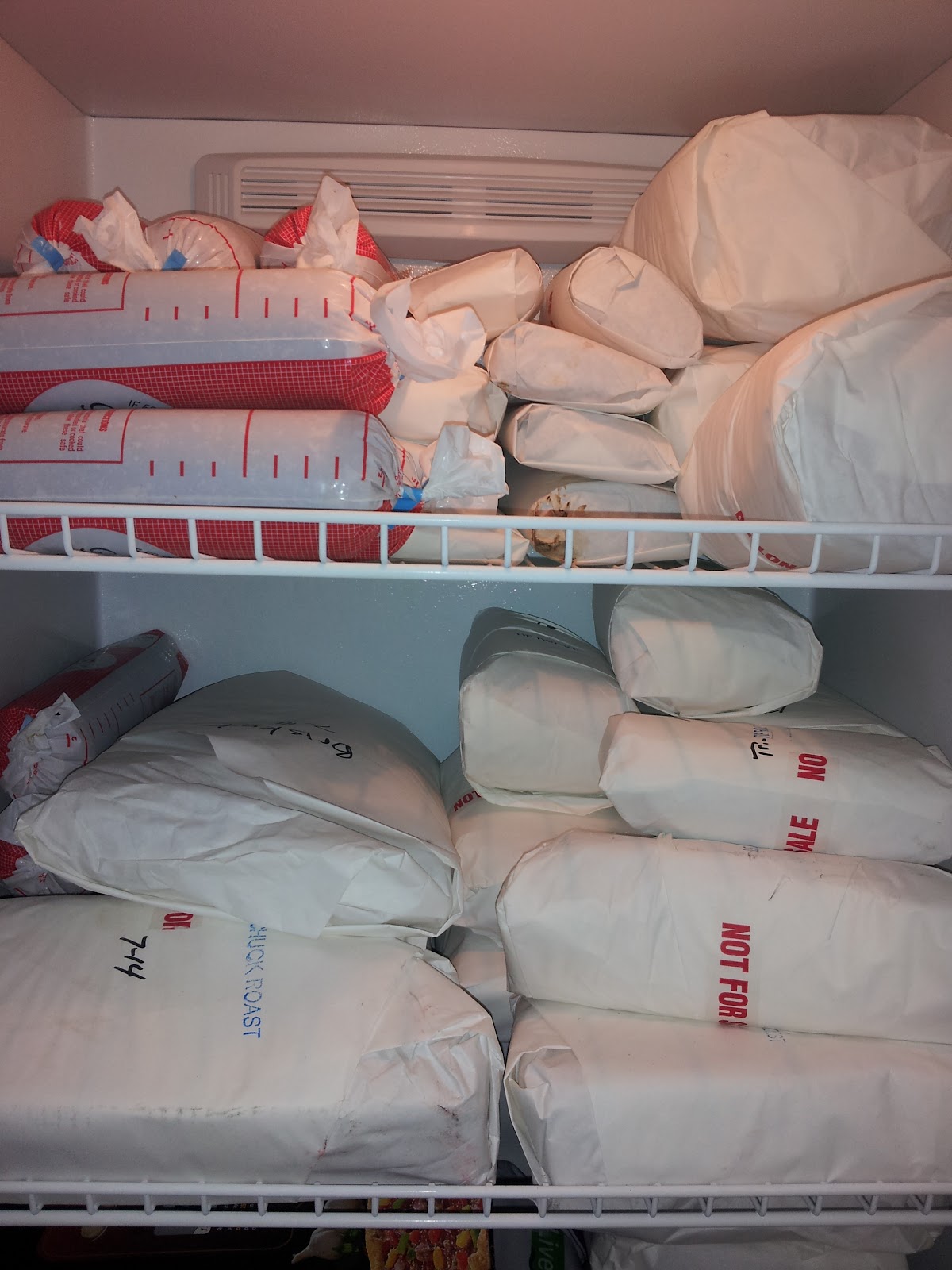
Yesterday we received our beef from the butcher. We have a bit of a problem with freezer space. There's still a lot of meat left over from previous years' animals, so it took some problem solving to make room for this year's cut order. As I organized various cuts, trying to make the most room I could, it felt a bit like playing a strange version of Tetris..."I can fit two packages of Sirloin on top of the T-Bones, and fit six bags of ground beef around the perimeter...hooray! I formed a new row!" 
Organizing last year's remaining beef in the freezer.
Then I thought about how it really was a pretty good problem to have. We get to eat our own beef that we raised ourselves on our farm. As my husband so eloquently stated last night, "I know about every bite of grass and feed that animal has eaten and every (poo) it's taken since it was born." He probably watched its birth, too. The only part of the cycle from birth to death to food on our table we miss out on is the actual slaughter and butcher process. For that, we have to outsource.

When I was growing up, my farm experience was pretty limited and our meat came from the meat counter at the grocery store. I can remember watching as my dad approached the meat counter and ordered a few cuts we'd use throughout the next week or so. I knew that beef came from cows, yes, but for me, it came from that meat counter at Fairway. We trusted that the store sourced their meat from reputable places. For most Americans, this is how meat is purchased. In some cases, people struggle to make the connection from living animal to food on their plate and have no idea how that cycle works. I feel pretty lucky and thankful to be integrated into that process, and to get to enjoy the tasty fruits (or meats?) of our labor.
Steak salad I made for lunch yesterday, including spinach from our garden.
My friend Stennie, who has been to our farm for extended visits a few times, has a really nice essay published on the topic of eating animals: Whose Muscle is On My Plate. She goes into the meat-raising and eating cycle in detail as she's experienced it in some of her work. Very interesting ideas, and ties in quite well, I think, with being thankful for one's food source and the methods used to raise and slaughter that food.

The longer I live here, the more I learn about how to prepare and cook with various cuts of beef. We certainly don't eat beef exclusively, but we do eat it more than I probably would if I were not living on a ranch. Jeff and I even had beef served at our wedding. Prime Rib, to be exact. Since I was definitely a newbie to beef cuts at the time, I remember asking during the wedding dinner exactly where on the animal a prime rib cut would come from. This produced lively discussion among my new in-laws, with Jeff and Tom and the rest of us, in our wedding day finery, gesturing and demonstrating on their own bodies where a prime rib would be located.

Because beef cuts are a common topic at our family dinners, my Mother in Law got me this awesome beef-cuts platter a few years ago for Christmas!
Since joining Team Beef Montana a little over a year ago, I now know even more about the health benefits of incorporating beef into a balanced diet. Beef has zinc, iron and protein, among other helpful nutrients, to help fuel your run and your recovery. It's an efficient source of protein, too, meaning that you don't need much to pack a big nutritional punch. And, a recent article in the Washington Post highlighted a study done right here in Montana, that showed that eating a cheeseburger after intense exercise can be just as good as refueling with other options. Check out the article to read more:  Need To Recover After A Workout? Eat A Cheeseburger.  I guess all those post-track meet stops taking the team to fast food weren't such a bad idea after all!
Image from www.beefitswhatsfordinner.com
Yesterday, I actually did get in a short three mile run and then followed it up with a delicious cheeseburger at dinner. There's not much better than a hamburger or cheeseburger fresh off the grill!
Team Beef sent me some cool stickers, right!?
With beef on my mind this week, it was pretty easy to be thankful for the abundance of it that we do have and to be thankful that we are part of the process of bringing quality beef to our own table as well as to those of consumers. Now, I'm off to get my workout in and you know what's for dinner tonight? Beef and asparagus stir fry! 

What are you thankful for this week?  Do you have any favorite beef recipes? What foods fuel your life?
Wednesday, March 11, 2015

Next Generation Advisory Council

I have some exciting news to start this post: I applied for and was selected to be on a committee through National Farmers Union called the Next Generation Advisory Council. My friend Jennifer encouraged me to apply along with her and we both made the cut! The two of us, along with five others from around the country will be serving on the council. The mission of the council is as follows:

(The council) will serve in an advisory capacity. They will be called upon as a focus group to provide feedback on current programs and outreach, as well as proposed ideas for the future. For example, the Council could offer feedback on convention speakers, breakout sessions, brochure content, etc. to ensure that we are speaking to the "next generation" of Farmers Union members. 

So, with that brief explanation, I now enlist YOUR HELP, dear readers! I would love input from YOU as to what this Next Generation Advisory Council should try to accomplish, in your opinion. If you are involved in farming or agriculture, please consider what you would be looking for in an advocacy organization. If you're not involved directly in agriculture, but, say, you love food and you love supporting people who grow food, think about how you as a consumer could better interface with people who produce food. Here are a few questions to get you thinking and hopefully responding:

What are the best ways an organization can communicate with you?

What do you want an organization, particularly an Ag organization, to do for you?

What are some ways that people involved in agriculture can better connect with consumers?

As a consumer, what do you want to know about your food and your farmer?

When considering joining a new organization (of any kind), what are the biggest draws? biggest deterrents? 

What do you feel is the "next generation" of agriculture?

What do you think is the future of food and food advocacy?  Who are the producers and who are the consumers?

What is your overall opinion of farmers and agriculture? 

Where do you get information about farmers and agriculture?

Thinking specifically about National Farmers Union or Montana Farmers Union, what are some reasons you like the organization? What are some reasons you dislike the organization?

I would really LOVE to hear from any of you on these topics! Or, if you have anything else to say that I didn't specifically address above, please let me know! Feel free to comment here on the blog, comment in Facebook, or even email me at katie (dot) r (dot) adam (at) gmail (dot) com. My first meeting with this group is this Sunday morning as part of the National Farmers Union Convention in Wichita, KS. I can't wait to read your feedback!

DrivingtheFuture

Monday, May 6, 2013

Seeding Photos

Over the weekend I was granted a reprieve from track meet duties to assist Jeff with seeding. It was really great to be helping with farmwork.  I helped Jeff by moving trucks and vehicles down the field or from one field to the next (yes, I drove the semi! thankyouverymuch!) and with filling the drill with seed and fertilizer. The weather was beautiful over the weekend, which made everything even more pleasant. Temperatures around 70, sunny, and minimal wind.  Sounds like a San Diego forecast, right?

I brought my camera on Saturday.  Since I haven't done a photo montage blog in a while, I guess this will be it! As usual, there are a few photos of Harvey...

Harvey: "I'm not supposed to be doing this, am I?"  Caught red-pawed!
Harvey cannot resist digging in soft dirt, especially when it smells like animals could be lurking below.  This looked to be a badger hole. This stubble strip was seeded shortly after this photo was taken.  Badger holes are really not great growing conditions for wheat and Harvey's extra digging probably didn't help. Oh well!

 We were seeding in a field adjacent to the house, just to the east.  Pretty nice view with, huh?

Big Truck, Medium Truck, and Small Truck. Actually, the small "truck" is would be a pickup. 

The left side of this photo is what just-seeded ground looks like. The right side is what it looks like just before being seeded.  With the air drill, we can seed directly into stubble, and don't usually need to plow or till the fields first. This is great for many reasons, one of such being that organic matter is retained in the soil.

Tractor pulls the air drill.  The cart in the back holds seed, nitrogen, and phosphorous.
 
Harvey was supervising the seeding operations.

Wednesday, December 19, 2012

Another Piece of the Puzzle

What happens to the crops from our fields after they go to the elevator? Here's an inside look at another section of the food-supply chain.

Last night, Jeff, Tom and I attended an open house at a newly opened pulse grain processing facility near Chester. The plant was formerly an aging grain elevator, poised for decline in business after the opening of two huge, brand new elevators in the area within the past year or so.  This factor combined with increasing bushels of pulse crops grown in the area made the elevator a good fit for the upgrade.

The elevator will now accept solely pulse crops-- yellow and green peas, chickpeas, and lentils, for example.  Green peas and lentils, specifically, will be processed within the facility. On the tour, I was able to snap quite a few photos and create this sort of photo tour.

It's hard to get an idea of the size of the plant from only these interior shots. It was dark outside already when we arrived, so I didn't bother taking any photos of the exterior.

Basically what happens is, farmers cut their crop in late summer and haul it to the elevator. At the elevator, it is processed and packaged before being shipped out to buyers around the world.  The night of the open house, they were processing lentils.  The first step was for sensors to identify off-color lentils and flush them out.  Tiny puffs of air separated individual lentil kernels from the whole.  We were told the off color kernels (and other "unusable" kernals, basically any kernels that didn't fit the quality standards) were separated out and are primarily used in gluten-free pet food.

Next, the lentils went through a series of large machines that cleaned out chaff and small rocks:
Jeff sticks his hand into the (not-running) machine, to give an idea of scale.
The machine in action. Lentils pour in onto this large tray with holes in it.
The holes are sized such that unwanted pieces fall through and the lentils stay on top.
After the cleaning process, the lentils are filled into 55lb bags and machine-stitched closed.
Finished bags of grain.
These are two of the company's premier products: Emerald Empire Lentils and "Natures Choice" green peas.
A robotic arm stacks bags of lentils onto pallets.
Pallets are eventually loaded onto boxcars and away they go!
 I found it interesting to see how product we raise in this area is handled after we drop it off at the elevator.  Several other reasons I am excited about the facility include:

  • Encouragement of crop diversity beyond wheat
  • The facility creates a few more jobs for the area
  • The building was "recycled" for a new purpose, rather than left abandoned.

They served lentil chili for dinner, which was really yummy!
Some samples of pulse grains this facility could take.
A few varieties of lentils, yellow peas, and green peas.
Pulse crops are destined primarily for human consumption.  Yellow peas (which Jeff and I grew for the first time this past season) and chickpeas are primarily ground into flour. India is the major buyer for these. Green peas and lentils are often unaltered after leaving a facility like the one in Chester. One company in the Philippines uses green peas to make a snack food.  
Philippino snack food, anyone?  
A sample of green peas used to impress buyers all around the world.
The marketing pitch from company representative was a little over the top and hard to swallow at times. I kept hearing the words to the old song "Sixteen Tons" as he spoke about contracts... "I owe my soul to the company store..." and seeing visions of Monopoly properties and price control... But if you can attend the presentation and read between the lines, you're OK in the end. Overall, it was a really interesting night.  The processing was really interesting and the global nature of the food supply was, too.  We will likely not contract with this elevator ahead of time, but, happily, we will still be able to bring our peas here if we need to or want to. In all, another piece of the food supply chain puzzle was filled in for me, and I can seldom pass up an opportunity to learn.