Showing posts with label corrals. Show all posts

Thursday, March 24, 2016

Twins

Have you been hankering for a glimpse into the life of the rancher during calving!? This time of year, we are quite the bovine maternity ward round here! In this post, you'll learn all about the extra special circumstances of when cows have twins. Special thanks to Jeff for helping me write this post and making sure I had my facts correct. Enjoy!

As I mentioned in my previous post, overall, everything is going very smoothly with the calving operation this year. The weather has been agreeable to late-night and early-morning walk-throughs, and we've had relatively few issues with the birthing process in our cows. Sure, we've had to assist in a few births by helping turn a calf who was coming backwards or even "pulling" a few to help the cow. That's pretty typical.

We've only had a few calves die, which is also good. Each year there are a few who get sick or are born with some sort of issue and just don't make it. Obviously, we do everything we can to help the calves and their mamas, but sometimes there's just nothing left to do.

And then there are the twins. We can usually count on one or two sets of twins born every year. While it is a good thing to have twins in a sense because, hey, we just got two-for-the-price-of-one, it can also place added stress on the mama cow. Typically, a cow produces enough milk to raise one calf, so twins can really put a strain on her ability to give the best nutrition to both calves. Also, sometimes the births themselves are much higher stress and almost always require assistance, or even a trip to the vet.

This year, we had three sets of twins. Sort of.
Our most recent set of twins. Keep reading to find out how they're doing!
When Jeff and I were gone to Minneapolis a few weeks ago, Jeff received a call from those manning the calving operation - Tom and our friend Jim - that we had lost a calf. It had been born dead. Not to worry, however, because the very next animal that calved had twins. They were able to "graft" one of the twin calves onto the cow who had lost her calf. Very serendipitous. Because the twins were born so soon after the other calf had died, the grafting took easily-- the mama who had lost her calf accepted one of the twins as her own calf, after a brief "warming-up" period.

A few weeks later, there was a cow who started acting really funny in the pen. She would stomp around, act a little territorial, and then began trying to claim the newborn calves of other cows. It's not unusual for a cow to have the first pangs of contractions, and look around, finding another cow's newborn calf, and confuse it for her own, thinking she had given birth. This cow did that with several others' calves. She showed signs of nearing calving, but hadn't given birth yet.  For a whole day, she could consistently be found causing a ruckus. We knew she was close to calving but something just wasn't right about her.

Finally, she started the actual calving process. Only, it was taking her quite some time and she was making very little progress. Jeff eventually went in to investigate, you know, going shoulder deep to feel around inside the animal. What he felt was what he thought were twins, but who were tangled up together inside. He and Tom attempted to sort them out but couldn't make progress at it. They called the vet, who instructed them to load up the cow and take her to town to be checked out. The vet ended up doing a C-section to get the calves out, but they both were dead. The vet's opinion was that one of the calves had probably died a week ago or more, and the other one may have been fine but it was tangled up with its dead twin, so the cow couldn't birth him correctly. Ultimately, there was nothing we could have done. Jeff loaded up the cow and took her home, stitches up the side of her belly.
So, this is what a post- C-section cow looks like. 
Again, serendipity would have it, that very shortly after this incident, another cow, actually a heifer, gave birth to twins. They are the two tiniest calves I have ever seen! One of them was quite weak, and was definitely not acting as lively as a calf should when it is first born. We thought for sure we'd lose him. Jeff and Tom piped some colostrum down him since he wasn't able to stand and suck on his own, and hoped for the best, but didn't really think he'd make it through the night, he was so weak. We all sort of agreed that with the teeny tiny size of these two calves and the way the one was sort of developmentally lagging, it seemed like they had maybe been born prematurely.

The next morning, on my early morning check, I couldn't bring myself to look in the barn to check on these twins. I just didn't want to start my day by finding a dead calf. But, fortune was on our side. Jeff called me later and said the calf was acting a bit more perky. The colostrum had done it's job and really seemed to be helping. The calf would make it after all! Both twin calves now seemed to be doing fine.
One of the twins with their birth mama.
She gives him a sniff...
...and lets him suck.
She's a heifer, so she's not quite all the way to being a full-sized cow. The calf could fit completely under her belly.
Gives you an idea of how small they were.
Only problem with these twins is that, having been born to a heifer, she has a very small bag (udder). In other words, she does not have much milk, even for two tiny calves. So, the idea light bulb struck that we could try to make a pair out of one of these twin calves and the c-section mama who had lost both of hers. We'd have our work cut out for us, though, as it had been two days since she had given birth via c-section to the dead calves. The longer you wait, the harder it can be to graft a calf. Add to the mix that she had become very nervous around humans and in enclosed spaces. I chalked this up to her having the traumatic experience of the entire c-section ordeal, but opinions are mixed on this. She also could just be a nervous sort of cow.

It took several days of locking her in a feeding chute in the calving barn and bringing the twin calf up to suck while she was penned in. Jeff and Tom tried everything they could think of to try to get her to claim him. She would let the twin nurse, but would never act like she had any interest in actually raising him. At times, she'd kick at him to keep him from nursing, but mostly the calf was getting fed. It just didn't seem like she would accept and raise him as her own, although the fact that he was able to nurse gave us some hope. Tom has always said in the past that if a calf can nurse enough from a cow so her milk passes all the way through him, and her scent/hormones are on his "hind end," the cow will then almost always take the calf. In this case, she'd sniff the calf, but never had any inkling of wanting to actually mother it, and always just escaped the barn immediately rather than trying to keep the calf with her.
Here's the c-section cow locked in the feeding chute so that the calf could nurse.
We had talked about different options. He could be a bottle calf that *guess who* would probably get to feed every day. Or, he could go to the neighbor's herd, who had just lost a calf of their own. Without settling on anything, we just kept trying to make it a pair with what we had, as futile as it felt at times.

Then one morning, probably fed up with the battle of wills between himself and the cow, Jeff just decided to go for it. He pushed the young, tiny calf out of the barn and into one of the larger pens. The cow immediately walked up to the calf and began licking him off and mooing at him-- as if she had just birthed him right then and there. Like, "Hey! I've been looking for you for over a week! Where have you been?!" Just like that, in spite of all of our best efforts, the pair was made.

Here's a short video Jeff took of the cow and calf-
https://youtu.be/VZy7tFTHND8

Now, every time I go out to do my walk-throughs, I check in on this man-made pair. Pretty much without fail, that cow is within two feet of the calf. She does not let him get away and appears to be very doting. Who knew!

So, that gives a glimpse into what goes on during calving, and especially the drama that can come with twins. I am proud of the attention and care given to our animals. Also, I think there's a lesson in there somewhere about an animal's will and instinct. People can try to influence their behaviors, but animals gonna be animals in the end. They'll do it their own way.

And just for fun... A friend of mine tagged me on Facebook with this cartoon. What do you think?!

Friday, October 11, 2013

Grab Hold of History

Look around this vast, open North Country and it seems so empty.  But wide swaths of open spaces belie a hidden inter-connectivity of people, place, and history, braided into the rope of ongoing story.  Out here, that rope is thick and rough, but has been touched, pulled, and knotted by many people over a long time.  On a warm, windy October Monday afternoon, we found ourselves in the corrals, adding another knot on our local story rope.
 
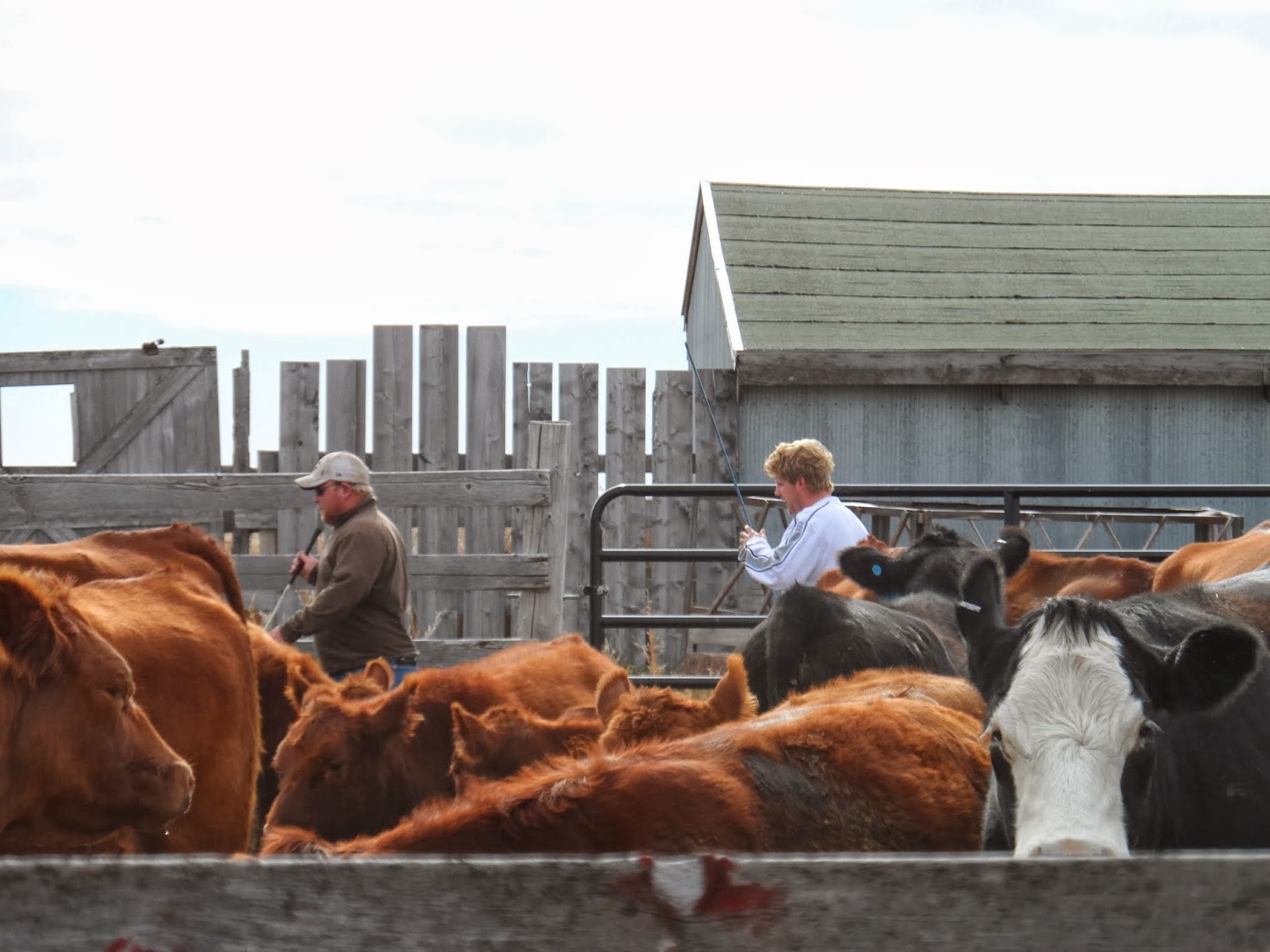
Jeff and Tom had spent the morning rounding up the herd of cattle and calves, driving them home into the corrals from pasture.  That afternoon they would be joined by Carol and me, and our neighbor Brett. We sorted calves from their mamas and prepared to run them through the chute.  They would be receiving fall vaccines and we would also select from the heifers those who would join our herd permanently.
Separated from each other, even for this brief period, the cows and calves were unnerved.  We worked in a cacophony of cow bellows and calf hollers, cows and their big babies yelling to each other across the holding pens. The wind blew dust all around, even through and around the protective wooden fence walls, swirling onto our skin and sticking to our sweat, lodging in wrinkles of clothing and finding its way under our sunglasses and into our eyes.  Despite the warmth of the day, many of us kept our long sleeve shirts and vests on throughout the afternoon as another layer of protection. It was windy and it was loud.
We began the vaccination process.  The calves, most all of whom were born less than 100 pounds in March and April had grown significantly. By now, most have them have reached or exceeded their shipping weight of just under 900 pounds for a steer. They had spent the summer on milk from mama cows with free access to high protein native grasses and plants.  To work them through the chute, a process they are not familiar with, can be a challenge. It is definitely hard work.
Just as we were beginning, some neighbors arrived. Dan and his son John had come to pick up two of their calves who had managed to escape their herd and join ours.  Since we were working our herd today it was an ideal day for them to pick up their two strays.  Dan and John are the real deal. Dan wears a cowboy had and sports a mustache, and not ironically. 

This is when past and present intertwined.  Dan and Tom are roughly the same age.  Both grew up in the area, farming and ranching with their own families.  Carol mentioned that in time gone by, their fathers, Lloyd and Kenneth, respectively, had done ranch work together. Likely they sorted and worked cows in these same corrals, Dan and Tom, as youngsters watching on, themselves helping as they grew up. Today, they worked together again. This time, their own sons and wives helping; the work of farming and ranching passing through another generation.  A similar history is true of Jeff and Brett as Brett’s family has worked with ours over the years as well.  It is likely that again, one day, our own kids will be watching or working along side us. 
 

So few occupations are passed through family members and generations like farming and ranching tend to be. Perhaps that is why Montanans are so proud to say what generation they are.  Jeff is a fourth generation Montanan, he and I carrying on the tradition began over one hundred years ago when his great-grandmother, Laura, homesteaded this land. I wonder if she could have had an inkling of what the future would hold. People have come and gone from this place over time, but some families have remained, toughing out the harsh weather and landscape as farming and ranching conditions have fluctuated over the years. As new generations come along, the elders of the community hand the knotted rope off. We grab hold of the history and add our own stories.

Monday, February 27, 2012

Calving Overview: It Has Begun!

Calving has started at Prairie Sun Farms.   There have only been a handful of calves born so far-- I think the total is around seven or eight.  There are around 108 cows total who were/are expected to calve, but it would be surprising if the end-number is exactly 108.  There is usually one or more calves lost to birthing difficulties, but there is often at least one set of twins, too.  So we can't say with certainty that there are one hundred to go- but it should be around that, give or take.

Calving season lasts about a month.  Our cows are bred the old-fashioned way-- the bulls are put with the cows late spring/early summer, with the targetted calving time being March.  No artificial insemination or embryo swapping here, just the good old birds and bees. 

When the due date for the cows draws near, they are held in pens in the corrals.  The heifers usually get their own pen, the cows that are determined to probably be "late-calvers" are in their own pen, and everybody else is in a pen of their own.  About every three hours (more or less often, depending on the weather), Jeff and Tom take turns walking through the corrals to check on the cows-- looking to see if any of them are getting ready to start calving.  The cows also get fed daily and get straw bedding for warmth. 

Usually the signs that a cow is about to start calving are distinct and I am getting better at recognizing these signs. Nevertheless, the labor period for cows, just like humans, is different for each animal and can vary greatly in length.  This is not a blog about biology, so I'm going to stop at that when describing these signs.

Calving is an exciting time.  Though it is a lot of work for ranchers to be so vigilant about checking and caring for the animals, the reward is the promise of new life and the great fortune to be able to witness it firsthand. Besides, baby animals sure are cute, and new, young calves are no exception!

Stay tuned for continuing updates on calving!  I will be posting photos and video peridically, too.  Check back often-- I hope each of you can experience the thrill of calving season along with us!